
Domestic market is losing its trend to rate sensitive stocks post the announcement of the new RBI governor who is likely to maintain a cautious stance on interest rate cut

The UN Conference on Trade and Development (UNCTAD) said in a report on Monday that a lower but positive economic growth in India in the post-Covid-19 pandemic period and India's large market will continue to attract market-seeking investments to the country. The World Investment Report 2020 by UNCTAD said that India was the 9th largest recipient of FDI in 2019, with 51 billion dollars of inflows during the year, an increase from the 42 billion dollars of FDI received in 2018, when India ranked 12 among the top 20 host economies in the world.

With this subdued forecast, India is likely to record its worst growth performance since the 1991 liberalisation. However, it is among the only two major economies, which will register a positive growth rate in 2020. The other being China, for which the IMF has projected a growth rate of 1.2 per cent.

The 50-share NSE Nifty stayed in the positive zone and retook the 9,900-mark to hit a high of 9,905.05 as buying paced up towards the fag end. It settled higher by 72.45 points, or 0.74 per cent, at 9,899.60.
Heavy unwinding by foreign portfolio investors and lacklustre equities dampened the sentiment

'Modi must keep his members in check or risk losing domestic and global credibility,' Moody's warned.

Sensex ends belowe 26,800 on domestic concerns.

Dealers attributed the rupee's fall to fresh demand for the US currency from importers
Asian shares ended higher following a relief rally in global equities after centrist candidate Emmanuel Macron won the first round of the French presidential election.

This weakness is likely to continue in the near-term.

Sensex closed over 118 points down on Thursday.

Sensex in green in afternoon trade.

Index heavyweight RIL surged 3% to end above Rs 1,000 mark while IT majors were also the top gainers.
The 30-share Sensex ended 53 points higher at 28,439 and the 50-share Nifty closed 18 points higher at 8,494.

The US dollar index, which measures the greenback's strength against a trade-weighted basket of six major currencies, was sharply higher by 0.62 per cent at 93.96.

The 30-share Sensex ended up 214 points at 27,890 and the 50-share Nifty closed up 52 points at 8,430.

Silver eased by Rs 150 to Rs 37,100 per kg lacking necessary buying from industrial units.

'Earnings revival could be two quarters away.'
The BSE index opened with negative gap of 4 points at 5,190 after a 7 point drop yesterday. A short spurt of buying, especially in PSU scrips has helped the markets bounce back into the green for a brief period.
Forex dealers said besides increased selling of the American currency by exporters and banks, the dollar's weakness against other currencies overseas also supported the rupee, but a lower opening in the domestic equity market limited the rise.

Rate-sensitive sectors like banks, realty and auto witnessed heavy selling pressure ahead of the RBI Monetary policy which is scheduled on September 29.

With an epic battle of billionaires for supremacy in one of the world's most prolific markets and a pandemic-propelled surge in online shopping in the background, India's nearly trillion-dollar retail market is hoping to touch 85 per cent of the pre-COVID business in the first half of the New Year. In a year when the COVID-19 carnage ripped apart the retail business, circa 2020 will best go down for the unravelling of the war between Jeff Bezos, the world's wealthiest man, and richest Indian Mukesh Ambani for pre-eminence in the booming market that is estimated to reach $1.3 trillion by 2025. It all started with Ambani's Reliance Industries agreeing in August to buy assets of the nation's second-largest retailer for Rs 24,713 crore, just a year after Bezos' Amazon purchased an indirect stake in the indebted Future Retail.

Financials are the top gainers along with index heavyweights.
The 30 share Sensex ended up 183 points at 27,470 and the 50-share Nifty gained 44 points to close at 8,295.
The broader market outperformed with the S&P BSE Midcap down 0.3%, while the S&P BSE Smallcap was little changed.

Sensex ended above 26,000 led by telecom shares amid TRAI's spectrum sharing norms.
Broad-based buying aided sentiment and the market registers record turnover at Rs 6.86 lakh crore

Top gainers among the S&P BSE Sensex include GAIL, Dr Reddy's Laboratories and Bharti Airtel, all edging up by 1% in late morning deals

The rupee had eased by 2 paise to close at fresh 2-month low of 62.78.

'The government has used the current macro situation to its advantage.'

Traders have all but given up attempting to predict where the new-year rout will end

Tracking local stocks, rupee on Tuesday regained 19 paise to end at 61.85 against dollar as reports of easing geopolitical tension between Russia and Ukraine helped emerging market currencies script a smart recovery.
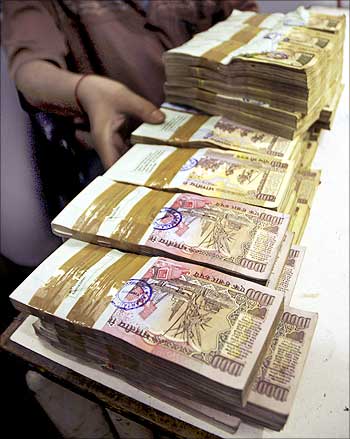
On Wednesday, the rupee had dropped by 26 paise.
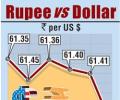
The rupee had ended almost flat at 61.41 against the Greenback in the previous session on Wednesday on alternate bouts of buying and selling.

In forward market, premium for dollar declined in view of mild receivings from exporters.

Net capital gains from the sector over a full cycle may be more than the gains logged by cyclical sectors.

Global gold demand hit an 11-year low in 2020 at 3,759.6 tonnes, mainly due to a weak October-December quarter and the COVID-19 related disruptions across the world driving a muted consumer sentiment throughout the year, the World Gold Council (WGC) said in a report. The overall consumer demand during 2019 was at 4,386.4 tonnes, while in 2009 the overall demand was at 3,385.8 tonnes, according the WGC's 2020 Gold Demand Trends report. Global gold demand dropped by 28 per cent year-on-year (YoY) to 783.4 tonnes in the fourth quarter compared to 1,082.9 tonnes during the October-December period of 2019, the report stated.

FIIs pump in $1.4 billion in March, after pulling out $2.9 billion in Jan-Feb.

The rupee had shed 13 paise to close at 64.04.
 © 2026 Rediff.com - Investor Information - Advertise with us - Disclaimer - Privacy Policy - Sitemap - Feedback - About us - Terms of use - Grievances